Book Club: Trust & Inspire
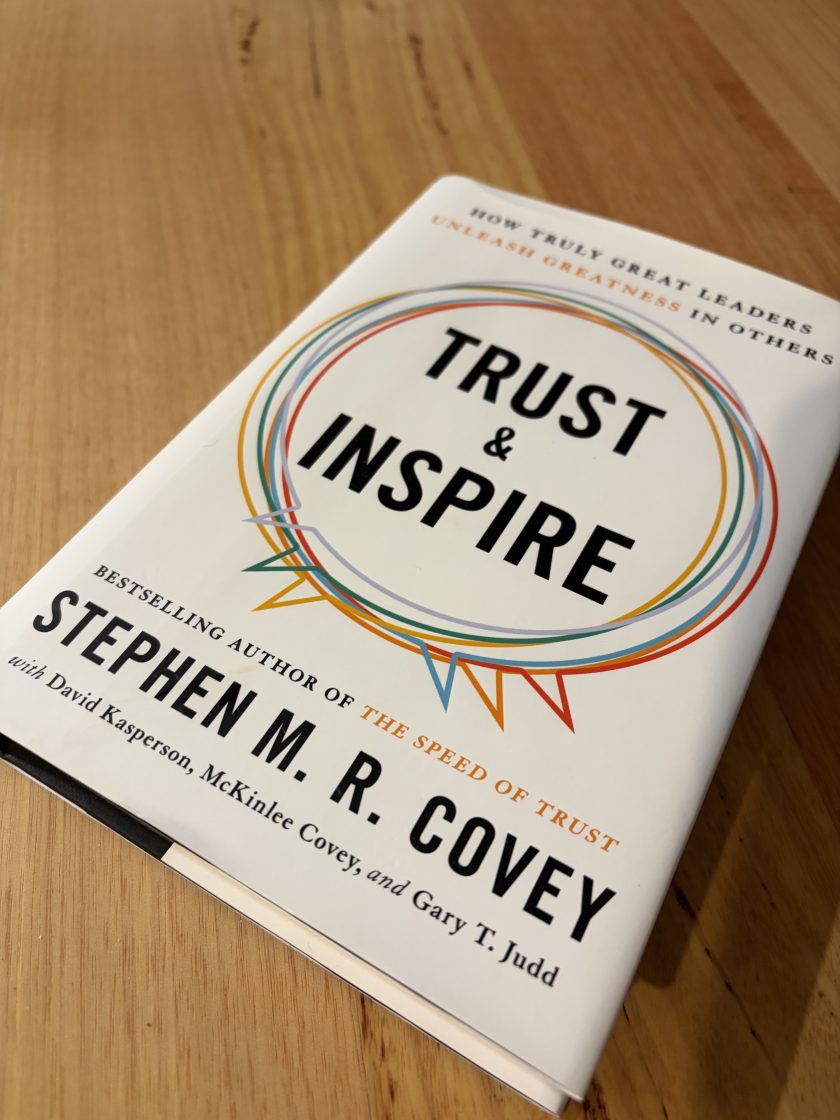
Trust & Inspire: How truly great leaders unleash greatness in others
There are leadership books you read, and there are leadership books that quietly affirm what you have come to believe through experience.
For me, Trust & Inspire by Stephen M. R. Covey was very much the latter.
Written by the son of Stephen R. Covey, this book builds on many of the foundational leadership principles that have influenced my own consulting and coaching practice over the years. In particular, I often draw on the ideas from The 7 Habits of Highly Effective People and Primary Greatness when working with leaders and teams navigating growth, culture and change.
I loved this book.
It resonated strongly with my leadership style and experiences across a range of workplace cultures. Throughout the pages, the text is supported with practical diagrams and at the end of each chapter there is a useful summary table comparing the behaviours of “Command & Control” leadership with “Trust & Inspire” leadership.
“Command & Control leaders don’t see power in people; rather they see power in the position.”
That distinction matters.
I have aspired to mimic characteristics of successful leaders I have worked alongside who create environments where people feel trusted, valued and capable of contributing meaningfully. Those leaders understand that leadership is less about directing people and more about enabling them.
This idea aligns strongly with something I have long believed:
Leadership is stewardship.
Leadership is not ownership. It is not status. It is not control.
It is a responsibility to care for people, culture, purpose and outcomes in a way that leaves things stronger than you found them.
One of the concepts revisited in the book from Stephen Covey senior’s work was the idea of the “five metastasising emotional cancers”:
- competing
- contending
- complaining
- comparing
- criticising
These behaviours quietly erode trust and collaboration within teams. They create cultures where energy is spent protecting territory instead of solving problems together.
A phrase from the book that stayed with me was:
“Rather than competing with each other, we complete each other.”
That idea connects closely with another quote referenced in the pages from Liz Wiseman:
“The person sitting at the apex of the intelligence hierarchy is the genius maker; not the genius.”
The genius maker. The one who creates more leaders. Strong leadership is not about being the smartest person in the room. It is about creating the conditions for others to contribute, think, challenge and grow.
Another referenced quote from Doris Kearns Goodwin:
“Good leadership requires you to surround yourself with people of diverse perspectives who can disagree with you without fear of retaliation.”
This is where I think some of our book club discussion became particularly interesting.
Not everyone in our facilitated leadership book club enjoyed this book as much as I did. Several members found it repetitive and felt they understood the core concepts relatively early in the 300-plus pages. Given our group has been meeting since 2018 and reads a minimum of four leadership books each year, many of the concepts were familiar territory for experienced leaders.
Our discussions also centred around what some viewed as idealistic rather than realistic leadership concepts.
What I personally took from the book reinforced by my own leadership experiences; that Trust & Inspire leadership is not about abandoning accountability or structure. It is not passive leadership.
In fact, Covey argues the opposite.
Trust & Inspire leadership works best when accompanied by what I term as clear frameworks, bumper bars, boundaries, clarity, consistency and expectations. Leaders still provide direction and clarity. They simply do so in a way that empowers rather than controls.
I appreciated the examples in the book that highlighted this nuance, such as clarifying when a discussion is genuinely seeking opinions versus when, as a leader, a decision has already been made and the team is instead being invited to shape the best path forward.
Likewise, the quote from Stanley McChrystal captured the importance of trust and judgement in complex environments:
“If, when you get on the ground, the order that we gave you is wrong, execute the order we should have given you.”
That level of empowerment only exists where trust exists first.
Another concept I appreciated deeply was the discussion around humility.
Humility is often misunderstood as weakness; soft, timid, passive or indecisive. Yet Covey reframes humility as something entirely different:
“Enormously strong, firm, courageous and active.”
The book also references an LRN study which found that leaders who demonstrate humility are eighteen times more likely to inspire colleagues than leaders who do not.
That finding feels particularly relevant in modern leadership where certainty and ego are often rewarded more visibly than curiosity, reflection and listening.
Another quote I highlighted immediately was:
“Courage is a choice based on your values, while fear is a reaction based on your emotions.”
Leadership frequently requires courage. Particularly the courage to trust people, to empower others, to hear dissenting perspectives and to relinquish the illusion of control.
I also loved the story of Fred Rogers using his children’s television program in the late 1960s to quietly challenge segregation by inviting a Black police officer character to share a paddling pool with him on screen. Sometimes leadership and influence occur not through grand declarations, but through simple acts that model humanity and inclusion.
Covey continually returns to the idea that leadership begins with self-reflection and intentional choice. One line I particularly loved was:
“Leaders are less made or born as much as they are reborn, again and again, through the choices they make.”
That feels both hopeful and deeply true.
Part of my own personal leadership purpose aligns strongly with developing others. It is the work that gives me energy. Covey reinforces this when he writes that leaders have the opportunity to become “a transition figure” in the lives of those they lead.
And as his father famously said:
“Leadership is communicating to people their worth and potential so clearly that they come to see it in themselves.”
This also reminds me of a quote I think of when coaching which is shared in the text, from Galileo:
“You can never teach a person anything; you can only help him find it within himself.”
Ultimately, that is what Trust & Inspire leadership seeks to do.
Not control people.
Not create dependence.
Not manufacture compliance.
But help people recognise and develop the capability that already exists within them.
One of the most powerful reflective questions in the book asks:
“How much more could those you serve accomplish if instead of monitoring for compliance you were mentoring for creation?”
That question stayed with me long after I finished reading.
At a time when many organisations are navigating uncertainty, disengagement and cultural fatigue, Trust & Inspire offers a valuable reminder that people generally rise, or withdraw, according to how they are led.
I highly recommend giving this book your time.
And if you would like to find out more about our facilitated leadership book club, please email me.